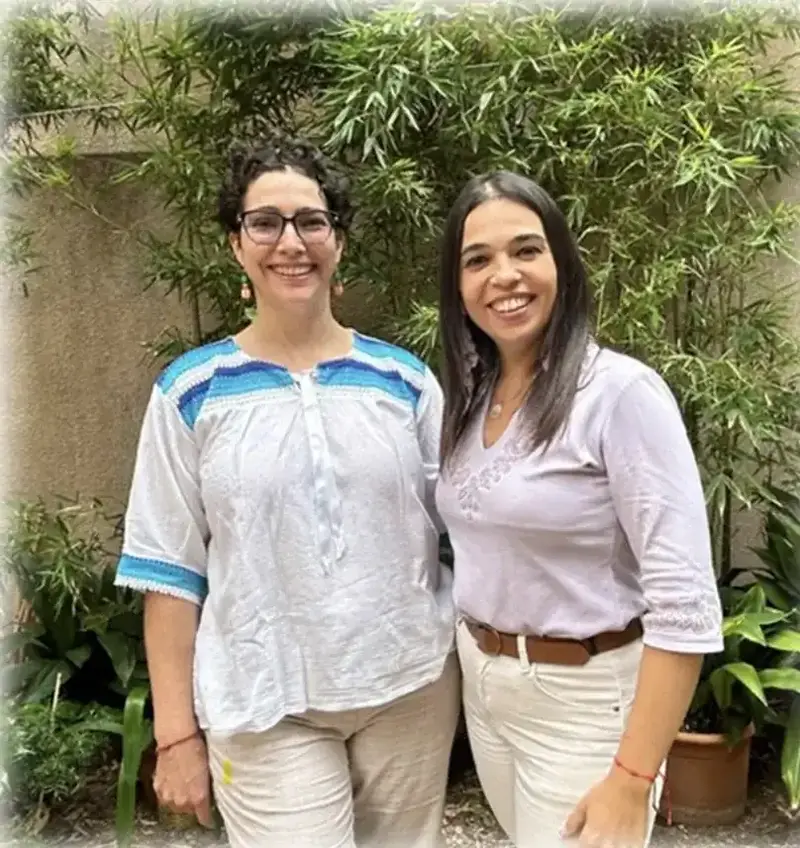
Voces que inspiran (Voices that inspire)
Interview published by KARL STORZ as part of its Diversity and Inclusion initiative, reproduced with their permission. Esther asks; Ona answers. The original PDF document is at the end.
Introduction
This interview is part of the Diversity and Inclusion initiative, whose aim is to give a voice to people who turn barriers into opportunities. Today we talk to Maria Ona Miró Manasanch, diagnosed with hereditary retinitis pigmentosa and now a leading figure in the world of paraclimbing. Through her story of effort, adaptation and positive attitude, Maria Ona inspires us to rethink visual impairment in terms of talent, determination and inner strength.
Short biography
Maria Ona Miró Manasanch has shown that limits can be turned into momentum. Living with a degenerative eye disease has not stopped her from growing professionally or from standing out in sport. She combines her work at the Hospital Clínic de Barcelona with paraclimbing, a discipline in which she has become a national reference, winning the Spanish championship in the women's B3 category. Her story is an example of determination, adaptation and passion for life.
Esther: How would you introduce yourself to someone at KARL STORZ who doesn't know you yet?
Maria Ona: I am Maria Ona Miró Manasanch. I currently work as an administrative assistant at the Hospital Clínic de Barcelona, where I deal with patient services. I have a visual impairment caused by a disease called retinitis pigmentosa and other conditions that derive from it. I have always loved sport and have practised several disciplines. At the moment I do yoga, strength training and aerial silks, and last year I entered the world of paraclimbing, where I compete. As the disease has progressed, I have had to adapt other sports I already enjoyed. Through ONCE I got to know different adapted-sport groups, such as tandem cycling and mountain hiking. Besides sport, I love being in contact with nature.
Esther: How would you define yourself as a person, if you had to do it in three words?
Maria Ona: Persistence, optimism, and I am a cheerful person.
Esther: Regarding your personal story, how did the diagnosis of retinitis pigmentosa come into your life?
Maria Ona: It was a slow and a fast process, both at the same time. Let me explain: it was slow because it coincided with the Covid period and I had to wait. However, once they were able to run the tests, the process was very fast. Afterwards it was a bit slower again, because the routine tests had to be done to determine the exact type of the disease, I had to be referred to the specialist (Dr Alforja), and access to ONCE had to be requested, which was fairly quick.
Esther: What was the emotional impact of receiving this diagnosis, and what support did you find?
Maria Ona: I remember it was a shocking moment and I was very frightened, both by the magnitude of the diagnosis and by the possible prognosis, since it is a degenerative disease. It affected the people around me a lot; fortunately I had the crucial support of those close to me. My mother has been key in this process: she has always added to it and motivated me to do things without limiting me at all. I got through the initial stage thanks also to the support of the whole ONCE team. Finding other people who were references for me, with the same disability or with others, was also very useful.
Esther: Did you ever feel that this condition would hold you back?
Maria Ona: I don't think it has ever held me back. My character, together with having people beside me who motivate and support me, has been fundamental.
Esther: What does overcoming mean to you?
Maria Ona: I think people usually think of overcoming as something more general, or tied to some specific goal to achieve. For me, though, overcoming is being able to do any everyday activity, because every day is already a challenge in itself. Being able to handle the different situations that come up as well as possible, and to do so with as much autonomy as possible in every area.
Esther: Which habits, values or mindsets do you think have helped you most on this daily path?
Maria Ona: What has helped me most is my character, together with optimism and humour. Humour helps a lot: if you take things positively, everything is much better. It is also important to have motivating people beside you who reinforce you with respect and companionship.
Esther: How have you managed your professional career while living with retinitis?
Maria Ona: I was able to access a special category within the hospital for workers with some kind of work-related difficulty, since my disability was recognised and I was registered with ONCE. I asked for a change of post because I felt I could not carry on where I was. The first post I asked for did not work out because it was very dark and caused me problems. So I asked for a second change, to a place with natural light and in patient services, which suited me better. I also asked ONCE to adapt my workstation. They have a great deal of knowledge and tools to assess and make the adaptations needed to make my tasks easier.
Esther: Did you meet barriers, or was support constant in your professional development?
Maria Ona: No, quite the opposite: I have always had a lot of support, from my manager and from my colleagues, both at the start and throughout my career. I never sensed any refusal when I asked for a change of post to be in better conditions, nor were there objections when ONCE came to adapt my workplace. They recommended that I tell my colleagues about my disability, which was very useful. Once I explained it, people understood my change of post and the reason for my adaptations. One difficulty with some disabilities is that they are invisible. If you don't explain that you have a problem, people don't know and are puzzled by certain strategies or behaviours you adopt. That is why I think informing and being well informed about abilities is very important in a company.
Esther: From your experience, what do you think a company should understand in order to be truly inclusive?
Maria Ona: The main thing is to be well informed. Information is very important to understand that there are different kinds of disability, some visible and others invisible. Also, even though some measures may be useful for many people, each individual needs specific adaptations. For example, someone with photophobia should not have their desk facing direct sunlight. I think that in general few measures are taken and many more could be. Sometimes they are hard to implement for architectural or financial reasons, but I believe the main limitation is lack of awareness. People don't think about the difficulties others face (such as stairs for a wheelchair, or too much light for someone with photophobia) unless they live with someone who has them.
Esther: What would you recommend to someone who has an invisible disability and finds it hard to talk about it at work?
Maria Ona: I would recommend that, if the person has a problem, they be brave. There is no need to shout it from the rooftops, because it is something that is hard to do. You can start little by little, perhaps telling the people closest to you first. It is a very personal task of courage and of accepting the problem in order to be able to explain it to others. Although you meet all kinds of reactions, mostly I have seen understanding and people drawing closer, even admiration. I think it is important to communicate it and explain it.
Esther: How did paraclimbing come into your life?
Maria Ona: It was a mix of chance and searching. Through social media I came across "Guies d'Arrel" (Àngels), who organises activities in nature for everyone, with any disability, together with Octavi, a mountain guide. I went climbing in Berga with them and loved it from the very first moment. The atmosphere hooked me: being on the rock and in nature, enjoying that great experience enormously and discovering an activity that was completely new to me. Then I looked for a way to keep practising more often, but I ran into various difficulties. Later, after a while, I contacted the Spanish paraclimbing team through Instagram and they put me in touch with the Catalan team. They invited me to a competition in Blanes and that is where I met them. I found the team was like a very encouraging family. I needed intensive training to be able to learn and improve, and that is when I contacted Sharma Climbing in Barcelona, who believed in me and in inclusion from the very start. Since then I train with them and we go to the competitions.
Esther: What was the experience of the competitions like?
Maria Ona: It all went very fast. I went to the Catalan competition in Blanes having climbed on rock only once before and never having competed. I became Catalan champion in my category, B3. A month later I went to the championship in Madrid. Before the final they interviewed me for Spanish public television. When they asked me how long I had been climbing, I said "Less than a month", and the interviewer was stunned! There I got to meet the members of the Spanish team from the different regions. It was also a great experience; it was harder because the climbing wall had been used in a world competition and was enormous, in size and in height. In that competition I could confirm something I had liked very much: the good, family-like, welcoming atmosphere, with the complicity, support and great camaraderie of everyone, cheering each other on as if we were not rivals but teammates. This year I was only able to do the Catalan Cup and the last round of the Spanish Cup, because of an illness that has been a real challenge to overcome, as I was not in good physical shape, but with the satisfaction of not giving up climbing even so and of keeping on improving every day for the next competitions.
Esther: Do you think sport is truly inclusive today, or is there still something to be done?
Maria Ona: I think what is missing, above all, is more visibility and acceptance, whatever a person's physical or mental condition, so that it can be practised alongside other people and so become truly inclusive. I think the most important factor is that the person who teaches or gives the classes accepts that you have a different condition. I also think it is essential that the club and the coaching staff firmly believe that anyone can practise that sport if they enjoy it. For example, in my case, the climbing gym where I train is very inclusive: they don't treat me differently. Although I have a guide (which is an adaptation), I train with the other climbers and do the same routes.
Esther: If you could talk to someone who has just received a difficult diagnosis, what would you tell them after your experience?
Maria Ona: I would tell them that the first moment is very hard. They will probably go through a series of emotions, such as despair and fear. But with time, and above all with acceptance, and by building a support network (people around them and people with the same or other disabilities), the situation becomes more acceptable and bearable, to the point where it becomes normal. And the most important thing is not to stop doing what they enjoy. If they feel like trying new things, they should know there are many ways of pursuing hobbies. Having a disability does not mean giving things up; it means doing them differently. In time they will find strategies or small changes that let them keep doing what they enjoyed, or even try new things.
Esther: What is your next goal, or your dream?
Maria Ona: My goal is the day to day: to try to stay as well as possible, in health and mentally, and to go on with enthusiasm and optimism. And to be able to keep doing everything I am passionate about, surrounded by all the wonderful, motivating people who are by my side.
From the KARL STORZ Diversity and Inclusion Group we want to thank Maria Ona for her generosity in sharing her story with us. We believe that diversity is a source of talent and that inclusion is built with real actions and examples like hers. Thank you for inspiring us to understand that abilities go beyond any limitation when there is attitude and opportunity.
"Having a disability does not mean giving things up; it means doing them differently."